
Emergency Air Duct Cleaning Near Me: What Lakewood Homeowners Should Do First
Shut the HVAC system off at the thermostat and the breaker before anything else. That’s the first move after a fire, a sewage backup, or a storm that pushes water and debris into the system, and it’s the one most Lakewood homeowners skip. The instinct when the power comes back is to hit the thermostat and see if things work. Running a contaminated system pushes soot, spores, or sewage particles into every room it serves. Here’s how to handle the first hour, and if you’d rather not sort it out alone, call (877) 492-2029.
Why You Need to Shut the HVAC System Off First
A forced-air system is a distribution network. Whatever sits inside the ducts gets carried to bedrooms, kitchens, and living spaces within minutes of the blower starting. After a house fire, the residue that settles in the return trunks and the supply runs includes fine soot and char particles that don’t behave like ordinary dust. They’re acidic, they’re small enough to stay airborne, and they coat surfaces that were never directly touched by smoke.
Sewage intrusion is a different contaminant with the same distribution problem. When wastewater backs into a crawl space or a utility closet and reaches ductwork, the system can spread biological contamination through the whole home. Floodwater is in the same category.
So the sequence matters. Turn the system off, keep it off, and leave it off until someone qualified has looked at the inside of the ducts. In our experience, the homes that come through a contamination event cleanest are the ones where nobody ran the heat “just to see.”
- Thermostat to OFF, not just to a low setpoint – a system in auto mode will still cycle the fan.
- Breaker for the air handler if you can identify it safely. If the panel is wet or you’re unsure, leave the breaker alone and call an electrician first.
- Close supply registers in the rooms nearest the source of contamination to slow passive drift.
- Don’t run ceiling fans or box fans near the affected area. They do the same thing the blower does.
Is It a Real Emergency, or Just Urgent?
Not every dirty-duct phone call is an emergency, and knowing the difference tells you who to call and how fast. A genuine contamination emergency involves a hazard that spreads while you wait. An urgent-but-not-emergency situation is a performance or comfort problem that needs professional attention but isn’t actively contaminating the house.
True emergency situations
- Post-fire soot in the system. Fire residue keeps off-gassing and migrating. Odor that returns every time the system runs is a sign the contamination is inside the ducts, not on the walls.
- Sewage or floodwater intrusion that reached ductwork, insulation, or the air handler cabinet.
- Visible mold growth inside ducts or on the air handler interior, especially after a leak or a long humid stretch.
- Pest infestation with droppings in the duct system – a health concern you don’t want circulating.
Urgent but not an emergency
- Heavy dust settling on surfaces a day or two after the system runs.
- A musty smell that’s noticeable but not overwhelming.
- Allergy flare-ups that track with HVAC use.
- A dryer taking longer than it should. That one belongs on the dryer vent cleaning side of the house, and it’s worth taking seriously, but it isn’t an air-quality contamination event.
If your situation is in the second list, you still want it handled properly. You don’t need to treat it like a hazmat call, but you do need a specialist who can verify what’s actually in the system rather than guess.
Document Everything Before Anyone Touches the System
Photograph before a single piece of equipment comes through the door. This is the step homeowners regret skipping, because insurance adjusters work from evidence, not memory. What you capture before cleaning starts is often the only proof that connects the contamination to the event that caused it.
- Wide shots of each affected room showing the relationship between the damage source and the registers.
- Close-ups of every supply and return register with visible residue, staining, or debris.
- The inside of the air handler cabinet if it’s safely accessible and the power is off.
- Any visible mold, especially where the duct meets drywall or where insulation is wet.
- Filter condition as it sits right now. A loaded filter is evidence of what the system has been pulling.
- Odor notes with dates – a written log of when the smell is strongest is genuinely useful to an adjuster.
Keep originals on your phone and back them up somewhere else. Adjusters and remediation contractors will want copies, and so will any company you hire. If a claim is in play, ask the company to document their own before-and-after condition as well. Professional duct cleaning should produce photographic evidence of the work, and that record belongs in your file alongside yours.
Questions to Ask When You Call After a Contamination Event
The answers reveal quickly whether you’re talking to a remediation-capable duct specialist or a general HVAC shop with a vacuum in the back of a van. Ask these directly, and listen for specific answers rather than reassurances.
- “What containment equipment do you use?” A real answer names equipment. Negative-air machines and HEPA filtration are the standard in remediation work. Lakewood Air Duct Cleaning Pros runs Abatement Technologies negative-air and containment gear on every job, which is the same class of equipment used in professional mold remediation.
- “Can you sanitize after cleaning, not just vacuum?” Debris removal doesn’t address microbial growth in a porous, humid duct interior. Sanitizing is a separate step, and it matters most after fire, flood, or sewage contamination.
- “Do you repair and seal ductwork, or just clean it?” Contamination events often damage or open the system. Cleaning a leaky duct and leaving it leaky solves half a problem. Duct repair and sealing in-house closes the loop.
- “What documentation do you provide?” Before-and-after photos, a written scope, and a description of the equipment used. If a crew can’t tell you what they did, you can’t prove it to anyone else either.
- “Are you a duct specialist or a general HVAC company?” This one is worth asking. A generalist rotating through unrelated trades is a different tool for a different job than a team that works on duct systems every day.
On timing: we answer 24/7. Fast dispatch from 7am to 7pm, Sunday through Friday. A call outside dispatch hours gets booked into the next opening rather than disappearing. We’re closed Saturday, so if a system fails on a Saturday, call and we’ll book you for Sunday.
Why Negative-Air Equipment Matters in a Contamination Emergency
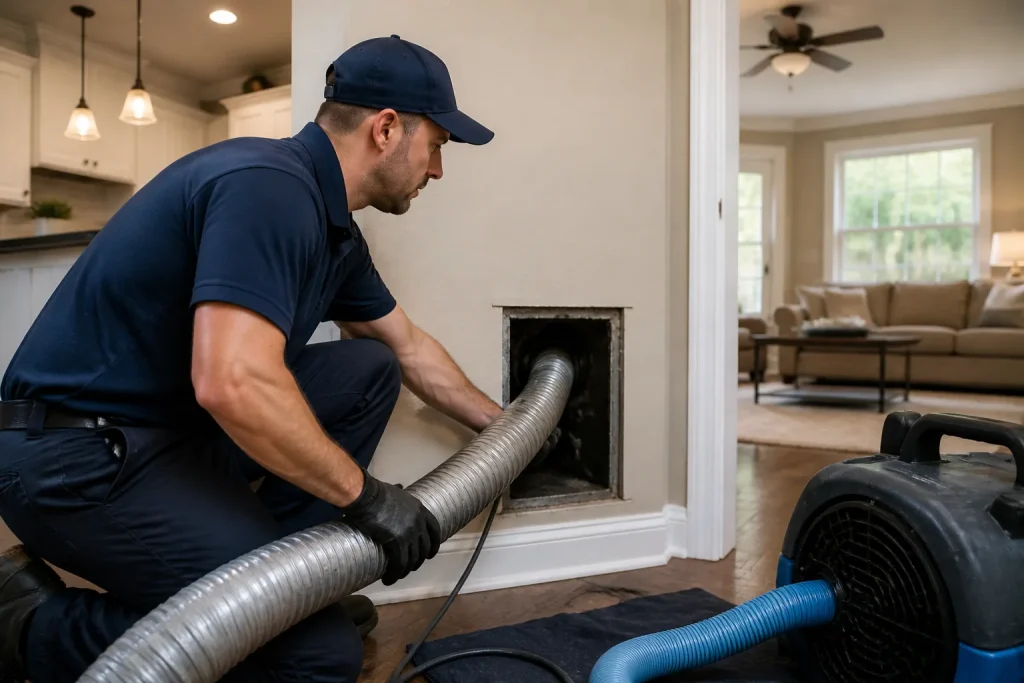
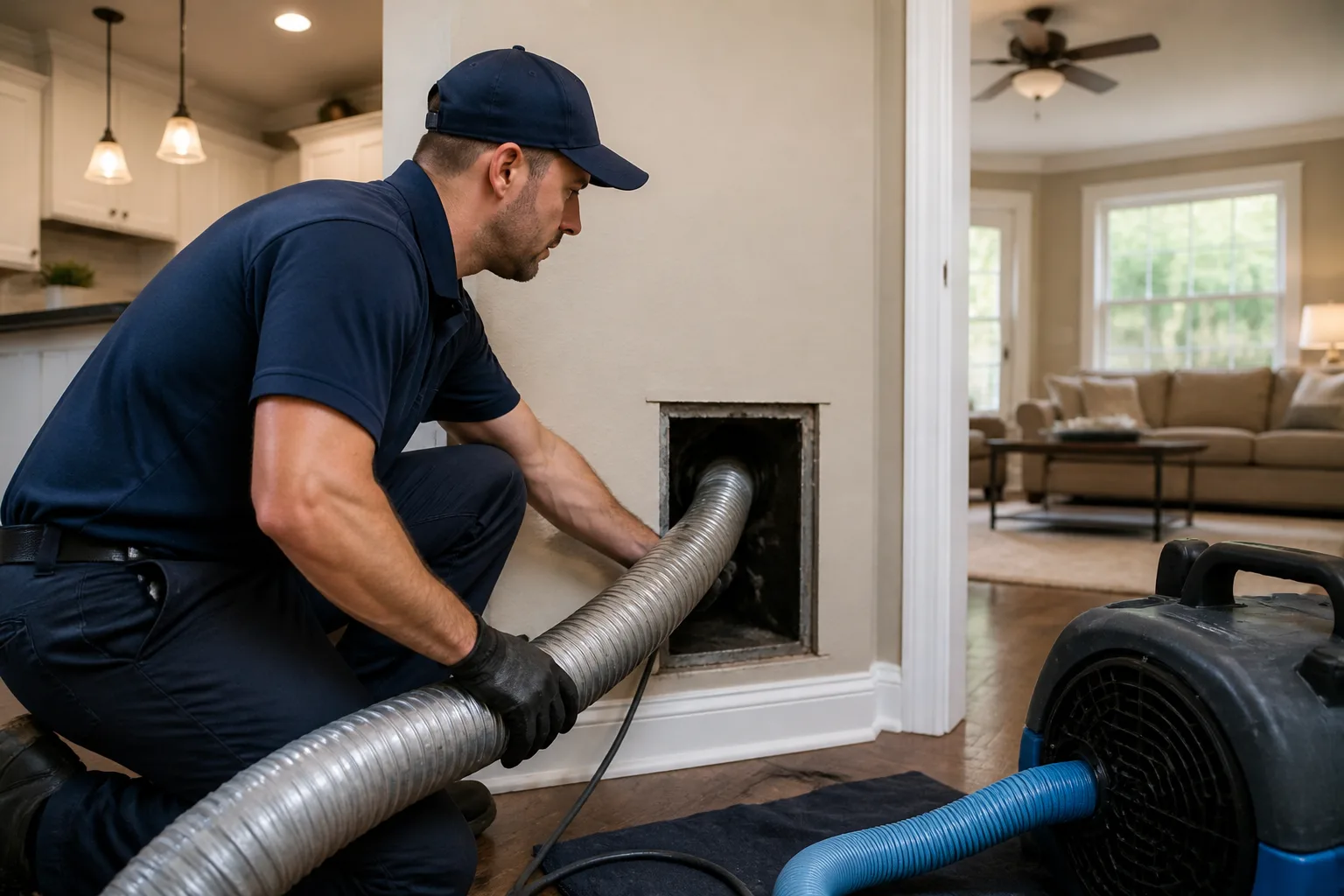
Pulling debris out of a duct with a shop vacuum is not the same as containing a contamination problem, and the gap between those two approaches is where remediation jobs go wrong. When soot, mold spores, or sewage particles get disturbed, they go airborne. If they aren’t captured at the source under negative pressure, they resettle in the same rooms they came from, sometimes on surfaces that were already clean.
That’s why professional remediation work runs on containment. Abatement Technologies negative-air units hold the work area at lower pressure than the surrounding space so particles move toward the machine rather than into the house. Nikro equipment handles high-volume HEPA collection through the duct runs. Rotobrush platforms give technicians controlled agitation inside the duct interior so dislodged material gets caught rather than scattered. These are the tools the remediation trade uses because they work on contaminated systems, not just dusty ones.
Beyond cleaning, the air quality side of a contamination job often involves filtration hardware. Honeywell and Aprilaire solutions can upgrade what the system does with the air it moves once the ducts are clean, and pairing that with Guardsman-grade sanitizing treatments addresses microbial growth and odor at the source instead of covering it. A specialist who can clean, sanitize, repair, and then improve filtration is handling one problem end to end. That matters after a fire or a sewage event, when patching together three vendors is the last thing you want to manage.
When to Call a Pro (and When You Can Wait)
Call now if the system ran after a fire or flood, if you can see mold inside the ducts, or if the smell gets stronger every time the heat or AC kicks on. Those situations get worse with time and with system use. If the air handler or a duct run is wet, treat that as a same-day call too, because moisture in an enclosed duct is where microbial growth starts.
For the air duct cleaning side of things, a standard cleaning can be scheduled rather than rushed. If you’re also dealing with a system that hasn’t been serviced in a long while, HVAC cleaning covers the components beyond the duct runs. What you should never do is let a contamination situation get handled by whoever answers the phone first. Ask the questions above, get a written scope, and confirm what equipment shows up.
Related services in Lakewood: air duct cleaning, dryer vent cleaning, and duct repair and sealing. One team, one scope, one set of before-and-after photos. We’ve seen enough half-finished remediation jobs to know the difference is equipment and follow-through, not effort.
The Bottom Line
In a duct contamination emergency, the decisions in the first 30 minutes do more for your home than the cleaning itself. Shut the system down, keep it down, photograph everything, and call a specialist who can tell you what containment equipment they run before they tell you a price. One flat price per system, agreed before work starts, is the standard we hold to, and the estimate is free and written. Our technicians have up to 8 years of experience on duct systems specifically, and the local pro is licensed and insured as their state requires. If you’re in Lakewood and need help, Lakewood Air Duct Cleaning Pros offers free estimates. Call (877) 492-2029. We answer 24/7, with fast dispatch from 7am to 7pm, Sunday through Friday.
Frequently Asked Questions
Pricing is set per system, not per vent, and the written estimate you receive before work starts is the final price for the agreed scope. A contamination job after a fire or sewage event involves more equipment, containment, and documentation than a standard cleaning, so the scope drives the number rather than a teaser figure. Call (877) 492-2029 for an exact quote. Estimates are free and written.
No. Running the system after a fire pulls soot and smoke residue out of the ducts and pushes it into every room the system serves, including rooms the fire never reached. Keep the system off until the inside of the ducts has been inspected. Air the house with open windows and closed registers instead.
Cheap quotes usually reflect a shop-vac-style approach with no containment, no sanitizing step, and no duct repair, which is a different service than contamination work. If soot or mold gets disturbed without negative-air capture, it resettles in the house and the problem returns. Ask what equipment is being used and whether sanitizing and sealing are included before comparing numbers.
You should get before-and-after photos of your own duct system, a written scope of what was cleaned and sanitized, and a description of the equipment used. Ask for those up front. Photographic documentation also matters for an insurance claim, since an adjuster wants evidence, not a verbal summary.
Written by the team at Lakewood Air Duct Cleaning Pros.
Need Air Duct Cleaning Help?
Call Lakewood Air Duct Cleaning Pros - the local pro we connect you with is licensed and insured, with free written estimates in Lakewood.
(877) 492-2029